
Will Legal Consumers Let AI Hire Their Lawyer?

Gyi TsakalakisPresident, AttorneySync
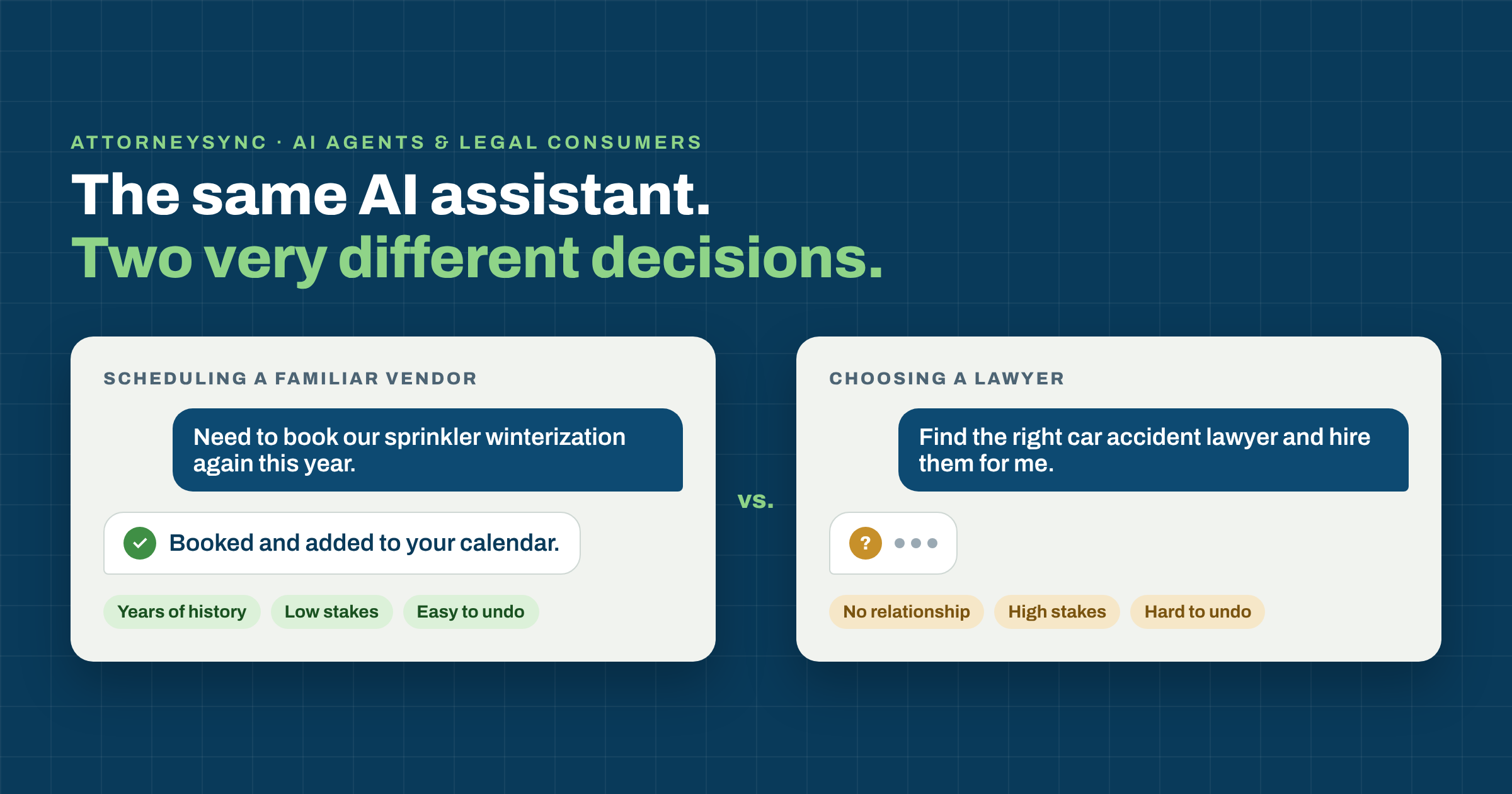
Recently, I scheduled our sprinkler winterization. Same company we’ve used for years. This time, an AI scheduling agent handled it.
It was a good experience. The appointment got booked, and I didn’t think twice about letting AI take care of it.
But context matters a lot here. I already knew the company, what they’d do, and roughly what it would cost. If the date didn’t work out, I could just reschedule. Letting an AI book a service I’ve bought every fall for years is a long way from letting an AI research, choose, and hire a lawyer.
That got me thinking about Google’s news this week, because AI agents are about to do a lot more of this kind of thing.
On November 17, Google made Tasks in Gemini free.
Tasks is Gemini’s agent mode. You flip the toggle on the home screen from “Chat” to “Task,” tell it what you want done, and it goes and does it. In Google’s announcement, Josh Woodward, who leads the Gemini app, describes asking it to get his minivan serviced. Gemini found the two nearest dealerships on Google Maps, called both at once, found an open time on his Google Calendar, and booked the appointment.
Until now, Tasks was only available to paid subscribers. It’s now free in the U.S., Japan, Korea, Canada, Australia, and India. In the U.S., calling isn’t available yet in Indiana, Louisiana, Minnesota, Montana, or Nebraska.
Now picture a potential client typing this:
“Find me a few car accident lawyers near me who have availability this week, call them, and book me a consultation with whichever one can see me first.”
As of this week, Gemini can try to do that.
Sprinklers vs. Lawyers
Here’s how I’d compare the two decisions.
My sprinkler company and I have years of history. Many people looking for a lawyer have never hired one before, and they’re choosing between firms they’ve never talked to.
I knew exactly what I was buying. Someone with a legal problem often doesn’t know what kind of lawyer they need, what it will cost, or what a good outcome looks like.
If the sprinkler appointment went sideways, I’d lose a morning. If someone hires the wrong lawyer, they can lose money, time, and sometimes their case. Switching lawyers midstream is possible, but it isn’t easy.
To schedule the sprinklers, the agent needed my address and a time. To hire a lawyer, a consumer has to share some of the most private details of their life.
And I wasn’t stressed. People usually look for a lawyer after a car crash, an arrest, a divorce filing, or a death in the family.
So, would someone in that position hand the whole thing to an AI? I’m honestly not sure. Let’s look at what the agents can do now and what consumers say they’ll trust them with.
From “Recommend a Lawyer” to “Hire a Lawyer”
A few years ago, I asked ChatGPT to recommend a personal injury law firm. It gave me a list. When I asked for sources, it pointed to directories, news, reviews, and awards. When I ran the same prompt again, I got a different list.
Since then, we’ve watched ChatGPT send consumers back to Google Maps and AI Overviews turn non-brand searches into brand searches.
In every one of those journeys, the AI did the research and the person picked up the phone. With agents, the AI makes the list and then makes the call.
So law firms now have a second question to answer. Will AI recommend us? And when it calls, will anyone pick up?
How Legal Consumers Will Actually Use This
Whether or not people ever hand the whole decision to an AI, I expect them to delegate in steps.
First, research. “What kind of lawyer do I need for this?” “What does a probate attorney cost?” “Who are the best employment lawyers in Detroit?” This is already table stakes.
Second, shortlisting. “Give me three family law firms near me with good reviews that offer free consultations.” The AI builds that shortlist from whatever it can find and verify about you: your Google Business Profile, reviews, website, directories, news, and what other people say about you. This is happening now too.
Third, outreach and scheduling. “Call these three and find out who can talk to me tomorrow.” This is the new part. An AI calls your intake line, identifies itself as an AI calling for a consumer, and asks about availability.
Fourth, the hiring decision itself. “Pick one and sign me up.” This is the open question.
Will People Trust AI to Do This?
The research I’ve seen so far suggests consumers will trust AI with the legwork long before they trust it with the decision. Accenture surveyed 25,590 people across 16 countries this year, and 74% said they’d trust a personal AI agent more than their best friend to make a purchase for them. That trust falls off fast as the agent gets more autonomy. Only 32% would let an agent decide what to buy, and that’s if they make the payment themselves. Just 9% are open to fully autonomous purchases.
Accenture found that what limits delegation is “not complexity but meaning.” The same person who lets an agent restock groceries might refuse to let it book travel.
And those are everyday purchases.
Hiring a lawyer sits even further out on that scale. It’s closer to my sprinkler example in reverse: no history, high stakes, and a lot of personal meaning.
Insurance is the closest comparison I’ve found. In a survey for the Independent Insurance Agents & Brokers of America, 87% of consumers said having a dedicated human agent still matters. People were fine with AI comparing quotes and answering general questions. But when asked about accidents, storms, or major claims, only 6% said they’d rely on AI alone.
Google seems to expect this as well. In the announcement, Woodward says Gemini won’t give out his payment or private account info unless he says so, and it’s designed to pause and check in before critical steps.
My guess at where trust lands:
- High: researching legal issues, building shortlists, comparing reviews, checking availability, and booking consultations
- Moderate: making first contact with a firm and sharing basic facts about the matter
- Low: choosing the lawyer and signing the engagement agreement
The catch is that the agent shapes the decision even when the consumer makes it. Say the AI shortlists three firms and only two answer the phone. It books consultations with those two. The consumer picks between two firms, and the third never knew it was in the running.
What This Means for Law Firms
Your intake has to work when the caller is an AI.
I’ve written about how many firms lose clients on that first call. Now imagine the first caller is an AI agent calling five firms at once. If your phone goes to voicemail, the agent moves on. If your receptionist hangs up because “it’s a robot,” it moves on. If nobody can answer “Do you handle this kind of case, and can you do a consultation tomorrow?”, it moves on.
Train your intake team on what to do when an AI calls. According to Google, Gemini discloses right away that it’s an AI. There’s a real potential client on the other side of that agent.
Google also says businesses can opt out of these calls. Before your firm does, think about who’s on the other end. If you opt out, the agent will presumably just call the next firm on its list.
Your information has to be accurate everywhere.
Agents work off data like hours, practice areas, service areas, phone numbers, consultation policies, and languages spoken. If your Google Business Profile says you’re open and you aren’t, the agent’s call fails. If your website doesn’t clearly say what you do and who you help, you probably won’t make the shortlist.
Your reputation still decides who gets the call.
The AI leans on the same signals that have always mattered in search: reviews, mentions, news coverage, recognition, and what real people say about you. I don’t know of a shortcut. Do good work for clients and make sure people can find out about it.
Your attribution is about to get messier.
When a client says, “My phone called you,” what do you put in your CRM?
Start asking a better intake question now: “Did you use an AI assistant, like Gemini or ChatGPT, to help you find us?” And keep a log of the AI calls themselves. They’re data, too.
The Bottom Line
An AI agent booked my sprinkler winterization, and I was happy to let it. I had years of history with the company and very little at stake.
Many people looking for a lawyer have neither of those things. They don’t know the firms, and the stakes are about as high as they get. On the other hand, the agents keep getting better, and people tend to get comfortable with things once they work.
Either way, the agent is already doing the legwork. If it can’t find you, can’t reach you, or has a bad experience when it calls, you won’t be one of the firms the consumer chooses between.
So I’ll leave you with the question I keep asking myself: will legal services consumers ever trust AI enough to hire a lawyer for them completely? Or will that last step always stay human?
I’d like to hear what you think.