
Is Your Marketing Agency Lying to You?
 Gyi TsakalakisPresident, AttorneySync
One of our clients sent me an email a few weeks ago.
It started: “I thought I’d share this interesting tidbit I learned from the old ‘how did you first hear about us?’ question…”
I love emails that start like that.
Here’s what happened.
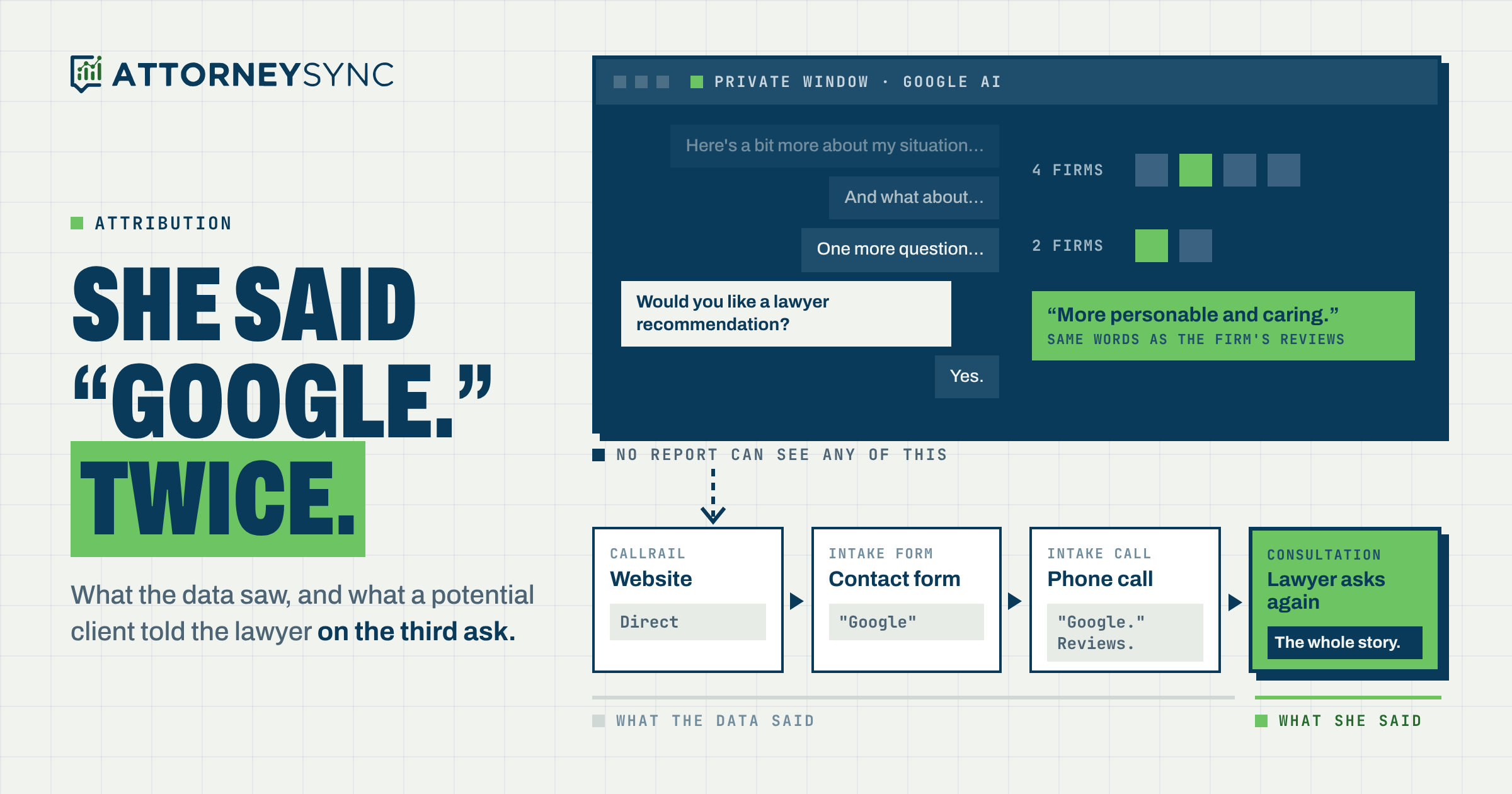
A potential new client found the firm’s website, filled out the contact form, and then called.
Here’s how her journey looked in the data:
CallRail? Direct website visit to the contact page.
Intake form, “How did you hear about us?” “Google.”
Intake call with staff? “Google.” The number of reviews, and what people said in them, is why she chose the firm.
Case closed, right? Google. Reviews. Done.
But then the lawyer asked the same question again during the consultation.
Maybe because it was the lawyer and not staff. Maybe because she was comfortable by then. In any case, she opened up.
She went to Google, opened a private browser tab, and started asking questions of what she called “the Google AI thing.”
A lot of questions.
She was skeptical of AI. Mostly curious. Playing around with it.
She kept feeding it background about her situation. Eventually, it asked her if she wanted a lawyer recommendation.
(She joked, “I guess it was tired of talking to me.”)
She said yes. It gave her four firms, including our client.
She kept asking. It narrowed the list to two: our client, and a big statewide firm that spends a lot on advertising and whose reviews are full of complaints about getting a new lawyer every time they call.
Gemini recommended our client. Why?
More personable and caring.
Those words come straight from our client’s Google reviews.
As our client put it: “When they are [open], boy, that question can pay off in spades!”
So, what actually got this client?
Not “Google,” exactly.
A long conversation with Google’s AI, in a private window, that pulled from reviews, then a separate visit to the website, then a form, then a call.
Now think about how that shows up in a typical agency report.
The SEO report sees a direct visit. Maybe a branded search.
The Google Business Profile report sees “Google” and reviews, and takes credit.
The ads report might claim it too, if the timing lines up.
The monthly recap says “Google” was the top lead source. Again.
Nobody’s report says, “An AI recommended you over a competitor because your clients say you’re personable and caring.”
Because nobody’s report can see it.
The AI conversation happened in a private tab. No cookies. No history. However she got from that chat to the website, the conversation didn’t come with her. By the time she landed on the contact page, the decision was already made.
The tracking was right. It just wasn’t the whole story.
Is that lying?
No. Not technically.
In my experience, most agencies aren’t lying to lawyers about attribution.
They’re just not very sophisticated about it.
They report the last thing they can measure, and give the credit to whatever they’re selling.
Here’s the problem with that.
If you believe this case came from your “SEO,” you’ll buy more of it.
If you believe it came from your Google Business Profile, you’ll push harder on review requests (not a bad idea, to be fair).
If you believe “Google” means Google Ads, you’ll raise the budget.
And you’ll miss the thing that won the case: years of treating clients well enough that they wrote about it, and an AI that read every word.
Don’t get me wrong. Nobody can see everything. We can’t either. A private-tab conversation with Gemini is invisible to every analytics platform I know of.
But a lot of agencies aren’t even trying. And worse, they’re reporting as if their data is the full story.
I’ve written before about how this is distorting brand vs. non-brand reporting, and how ChatGPT is quietly getting mixed into your Google Business Profile data. This is the same problem, from the client’s side of the table.
How to protect yourself
1. Ask the question. Then ask it again.
“How did you hear about us?” gets you “Google.”
“Walk me through how you found us” gets you a story.
“What did you search for?”
“Who else were you looking at?”
“What made you pick us?”
Our client got the real answer on the third try, from the lawyer, once the potential client was comfortable. You won’t get that on every case. Not everyone wants to keep talking. But when they do, write it down.
2. Treat “Google” as a category, not an answer.
“Google” can mean ads, Local Services Ads, the map, organic results, an AI Overview, AI Mode, or Gemini.
Those are very different things, sold by very different people.
If your intake form has one “Google” box, you’re throwing information away.
3. Put the self-reported and the tracked data side by side.
When CallRail says “direct” and the client says “Google AI,” neither one is wrong. The gap between them is the interesting part.
Ask your agency to show you where they disagree. If they’ve never looked, that’s an answer.
4. Ask your agency what they can’t see.
A good agency will tell you.
A good agency will say “we don’t know” when they don’t know.
A good agency will help you build better intake questions instead of just a prettier report.
If the answer is “we track everything,” be skeptical.
(Good luck tracking a private tab.)
5. Invest in the things AI is reading.
This potential client wasn’t won by a keyword. She was won by reviews that said “personable” and “caring,” and by a competitor whose reviews said the opposite.
AI is summarizing your reputation to people before they ever call you.
That’s not a marketing report line item. It’s your client experience.
So, are they lying?
I don’t know your agency.
But I do know this: your clients are taking paths to your firm that most marketing reports can’t see.
The data says “Google.”
Your client says “Google.”
The real answer was a conversation with an AI, in a private window, about how you treat people.
You’ll only hear that if you keep asking.