
Sizing a Law Firm Growth Budget: A (Made-Up) Example

Gyi TsakalakisPresident, AttorneySync
This is part two of a series on planning law firm marketing for 2027. If you missed it, start with part one.
Let’s make it concrete.
Again, this firm isn’t real. I made up the numbers to show how the pieces fit together. Please don’t copy them.
Meet Main Street Injury Law. Five attorneys. One office. Mostly auto, some premises, the occasional trucking case.
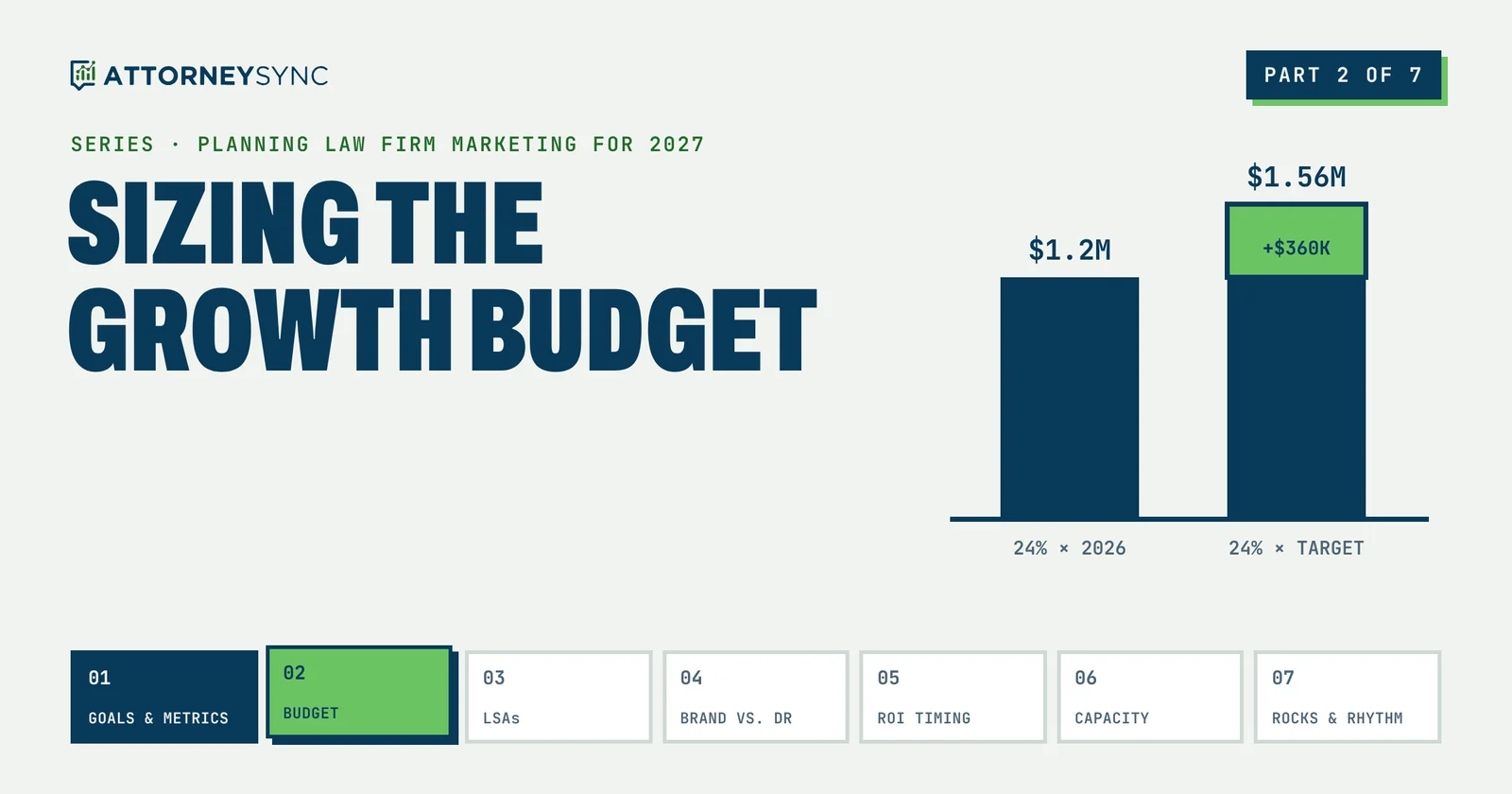
This year, Main Street did about $5 million in revenue. They spent $1.2 million on marketing (24% of revenue) and signed 300 new cases. In other words, about $4,000 per case.
| Channel | Spend | New Cases | Cost per Case |
|---|---|---|---|
| Google Ads (search) | $480,000 | 80 | $6,000 |
| Local Services Ads | $180,000 | 60 | $3,000 |
| SEO & Google Business Profile | $240,000 | 70 | $3,429 |
| TV & streaming | $300,000 | 40 | $7,500 |
| Referrals & past clients | — | 50 | — |
| Total | $1,200,000 | 300 | $4,000 |
(Yes, I know. Referrals aren’t free. More on that in a minute.)
The partners want to be a 10-attorney firm in three years. So, for 2027, they want to grow 30%.
Of what?
Revenue first. 30% on $5 million is a $6.5 million target.
Now the budget. This is where I see a lot of firms go wrong. They apply their marketing percentage to this year’s revenue. 24% of $5 million is $1.2 million.
Same budget as this year.
You can’t fund a 30% bigger firm with last year’s budget.
So, Main Street applies its percentage to the target. 24% of $6.5 million is $1.56 million. That’s $360,000 more than this year.
Is 24% right? For Main Street, in this example, sure. For your firm, I have no idea. What firms spend on marketing as a share of revenue is all over the map.
(And yes, I also know cases signed in 2027 won’t pay fees in 2027. That gets its own post (part five, coming Saturday, Nov. 21).)
Then the cases. 30% more is 390 new cases. At about $4,000 each, that’s $1.56 million. The budget and the case goal line up.
Then the hard part. Where do 390 cases come from?
You can’t just multiply every channel by 1.3. Some have room to grow. Some are tapped out. And in the channels already working hard, the next case usually costs more than the last one.
So, I don’t ask what a case costs on average in a channel. I ask what the next one will cost.
I sort channels into three buckets:
- Harvest: working, with room to grow.
- Maintain: working, but close to tapped out.
- Build: won’t pay off this quarter, but makes everything else cheaper later.
Here’s how Main Street’s (made-up) 2027 plan might look:
| Channel | Bucket | Budget | Target Cases | Target Cost per Case |
|---|---|---|---|---|
| Google Ads (search) | Harvest | $620,000 | 95 | $6,526 |
| Local Services Ads | Maintain | $200,000 | 65 | $3,077 |
| SEO & Google Business Profile | Harvest / Build | $300,000 | 100 | $3,000 |
| TV & streaming | Build | $340,000 | 50 | $6,800 |
| Referral & past client program | Harvest | $100,000 | 80 | $1,250 |
| Total | $1,560,000 | 390 | $4,000 |
Google Ads gets more money and a higher cost per case. That’s diminishing returns. Fine, as long as it stays under the ceiling the partners agreed to.
SEO and TV get a little cheaper per case. That’s the brand starting to compound.
Referrals get a real budget for the first time. In my experience, referrals are the cheapest source of cases most firms have. And most firms treat them as an afterthought.
LSAs barely move. There’s a reason for that, and it’s the next post.
Is this budget going to be right?
Nope.
That’s what the weekly Scorecard is for. If Google Ads cases cost $8,000 by March, money moves. If referrals outperform, they get more.
Your version will look different.
It should.
Next up: Why You Can’t Just Spend More on Local Services Ads