
25% of What? Planning Your Law Firm's Marketing for 2027 (the EOS Way)

Gyi TsakalakisPresident, AttorneySync
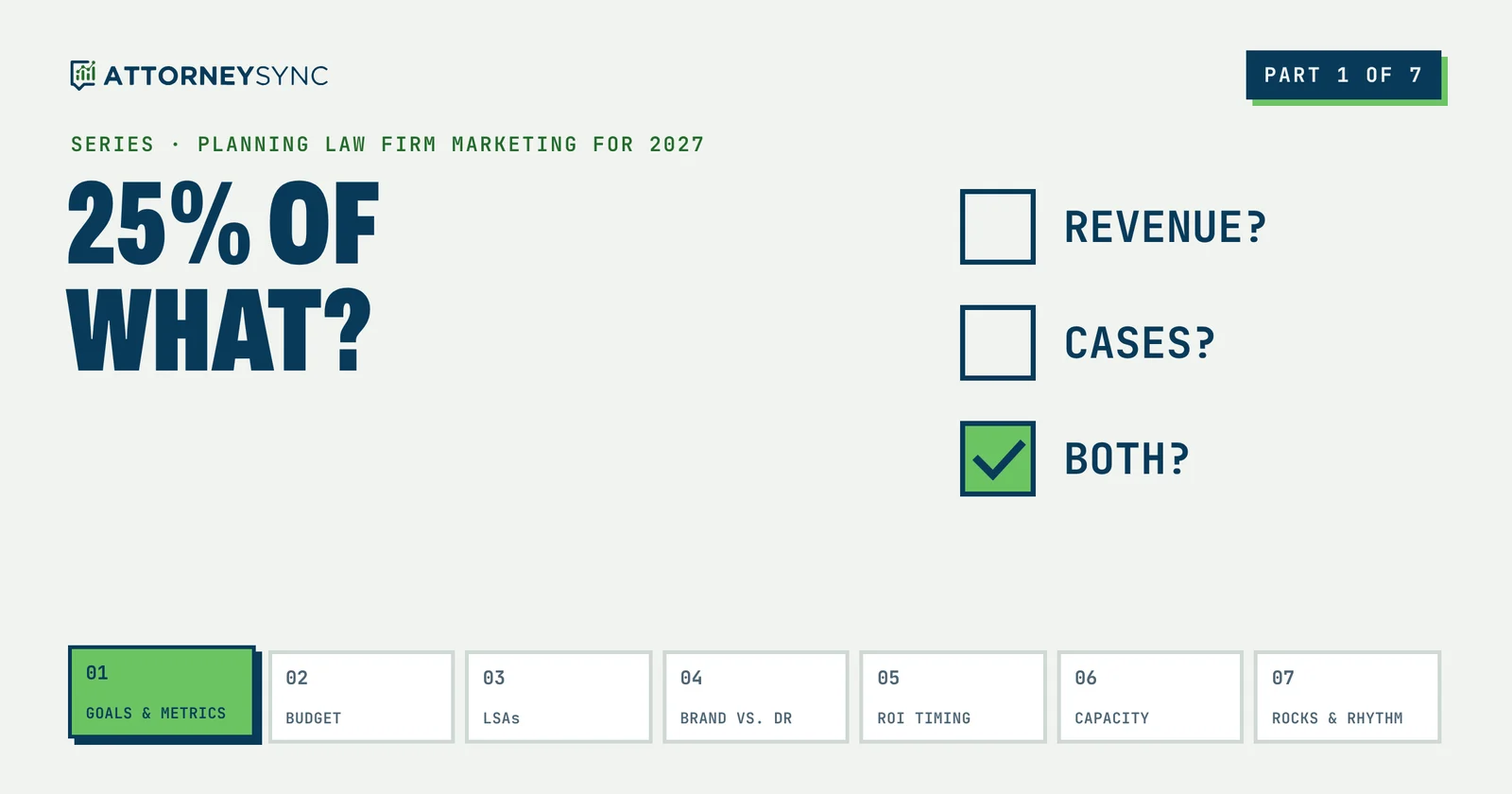
Every year around this time, I have some version of this conversation with a managing partner.
“We want to grow 25% next year.”
“Great. 25% of what?”
Pause.
“Revenue? Cases? Both, I guess.”
This isn’t a knock on anyone. These are usually great lawyers running busy firms. But “grow 25%” isn’t something you can build a marketing plan around.
It’s a feeling.
So, we work backward.
How many cases did you sign this year?
How many more do you need?
Can your team handle them?
Where will they come from?
What will they cost?
What happens if we’re wrong?
We don’t end up with a perfect plan. But we end up with one that has numbers in it.
In my experience, most firms never have this conversation. January shows up, the phones ring, and the firm runs last year’s marketing again (good luck).
A lot of you are probably in planning season right now, so I figured I’d jot down how I think about it. It got long, so it’s a series. Links are at the bottom.
First, the warning: I have no idea what the right numbers are for your firm. Later in the series, I use a made-up example firm. It isn’t real, and the numbers aren’t benchmarks. Goals, budgets, cost per case, and capacity vary a ton from firm to firm. I’m sharing a process, not answers.
Why EOS?
Plenty of law firms run on the Entrepreneurial Operating System (EOS). If you’ve read Traction, you know the drill. If you haven’t, you don’t need to adopt EOS to use any of this.
The pieces that matter for marketing are simple: a vision and a 1-Year Plan, a weekly Scorecard, quarterly Rocks, an Issues List, and a weekly Level 10 meeting.
What makes it work is the rhythm. Annual planning sets direction. Quarterly planning sets priorities. The weekly meeting keeps everyone honest.
Marketing at most law firms has no rhythm.
Somebody signs a contract. Somebody else gets a monthly report. Nobody reads it. Twelve months later, the partners argue about whether it “worked.”
Start by looking back
Bring data, not vibes.
How many inquiries did you get? From where?
How many were qualified?
How many signed?
What did each channel cost?
What fees did those clients generate (as best you can tell)?
If you can’t answer these, congratulations. You just found your first Rock.
While you’re at it, put the uncomfortable stuff on the Issues List. The directory listing you’ve paid for since 2014. The sponsorship nobody can tie to a single case. The agency that sends ranking reports but can’t tell you how many clients you signed. 🤔
Then decide where you’re going
I wrote a few years back that the firms that define future success in business terms have the best track record of hitting their forecasts. I still think that’s true.
What does the firm look like in three years? Revenue? Attorneys? Practice areas? Offices?
What does that mean for next year?
“Grow” can mean more revenue, more cases, bigger cases, or a new office. Those need very different marketing. A PI firm chasing more cases needs a different plan than one chasing bigger cases.
Get specific. Write it down.
Pick the metrics that matter
This is where a lot of firms go sideways.
They measure what’s easy. Traffic, rankings, impressions, clicks. Those aren’t useless. But you can’t pay your expenses with traffic.
For a marketing Scorecard, I’d work backward from revenue: signed cases by source, consultations, qualified inquiries, total inquiries, spend, and cost per signed case. Then add a couple of leading indicators, like branded search volume, new reviews, and referrals.
That’s it. You don’t need 40 metrics.
A few rules I’d hold to:
Every number gets one owner, and that owner is a person.
Every number gets a goal. Otherwise, it’s trivia.
Define “qualified” and write it down. Otherwise, the Scorecard turns into a weekly argument.
And don’t confuse attribution with truth. Use more than one source and look for trends.
Once you know where you’re going and what you’re measuring, you can finally talk about money.
That’s next.
The series
- 25% of What? Planning Your Law Firm’s Marketing for 2027 (you are here)
- Sizing a Law Firm Growth Budget: A (Made-Up) Example
- Why You Can’t Just Spend More on Local Services Ads
- Brand vs. Direct Response: How Should Law Firms Split the Budget? (coming Friday, Nov. 20)
- “But What’s Our ROI?” Plaintiff Firms and the Wrong Timeframe (coming Saturday, Nov. 21)
- Don’t Buy Growth You Can’t Serve (coming Sunday, Nov. 22)
- Set Goals, Cut Most of Them, and Prioritize All Year (coming Monday, Nov. 23)