
I Was a Direct Response Guy. Then I Watched People Hire Lawyers.
 Gyi TsakalakisPresident, AttorneySync
Jeff Berman and I started AttorneySync in 2008.
Back then, SEO had a reputation problem. Search ads promised things like “Rank #1 In Google In 48 Hours!” One of the first posts I wrote on this blog, in 2009, was called “Like Lawyers, Everyone Hates SEOs Until You Need One.” It was about how lawyers could avoid the shady ones.
We wanted to be the SEO firm lawyers didn’t have to hate.
So we were performance marketers. Direct response. Mostly SEO, some PPC. We spent a lot of time explaining what was actually on a Google results page, and why some personal injury firms were paying upwards of $100 per click. We called out agencies that were also working for the firm down the street. To this day, we won’t work with our clients’ local competitors, and we don’t do long-term contracts. We have to earn it every month.
If you couldn’t tie it to a call, a form, or a signed client, we weren’t very interested.
By 2012, we were beating the Rankings ≠ Traffic ≠ Inquiries ≠ Clients drum. I still believe every word of it. Show me the clients.
That accountability is still the foundation of everything we do. Monthly. Exclusive. Results. I’m proud of it.
But I’ll admit it. For most of my career, I was a direct response guy.
Brand? Awareness? Billboards?
That was for firms with more money than spreadsheets.
The funny thing is, the clues were there from the start. In another one of our earliest posts, I told lawyers to spend 15 minutes a week on Facebook, while admitting that “Facebook users are trying to keep in touch with friends, not searching for professional services.”
In other words, people weren’t looking for a lawyer there. But they were there. Living their lives. It took me a lot longer than it should have to understand why that mattered.
And don’t get me wrong, direct response works. Some people really do search “car accident lawyer near me,” click the first thing that looks credible, and call. Those are real clients. We’ve helped a lot of firms sign a lot of them. I’m not here to tell you to stop chasing them.
I’m here to tell you that, in my experience, they’re a much smaller part of the story than most of us want to believe.
What changed my mind
It wasn’t one thing. It was years of things that didn’t add up.
The intake notes didn’t match the reports. Our data said a client came from an organic search. The intake notes said, “My cousin used them,” or “I’ve seen their commercials forever,” or “I’ve been following her on Facebook.”
Then there was brand. When we actually segmented the data, a big chunk of the “SEO” calls came from people searching the firm’s name. They already knew who they wanted. I’ve ranted about agencies taking credit for this before, and honestly, early on, I’m not sure I was always innocent either.
And I can’t tell you how many times I watched a firm that ranked for everything get out-signed by a firm that ranked worse but had a better reputation and a name people recognized.
But what really did it was watching people.
Through our research partnership with Near Media, we watch recordings of real people looking for a lawyer and thinking out loud as they go. (I wrote more about what we’re seeing here.)
They start with a generic search. Sure.
Then they refine it. They open Maps. They read reviews. They go back. They check a directory. Some ask ChatGPT. Some go to Reddit. And over and over, what started as a non-brand search ends with them picking a firm they already recognized.
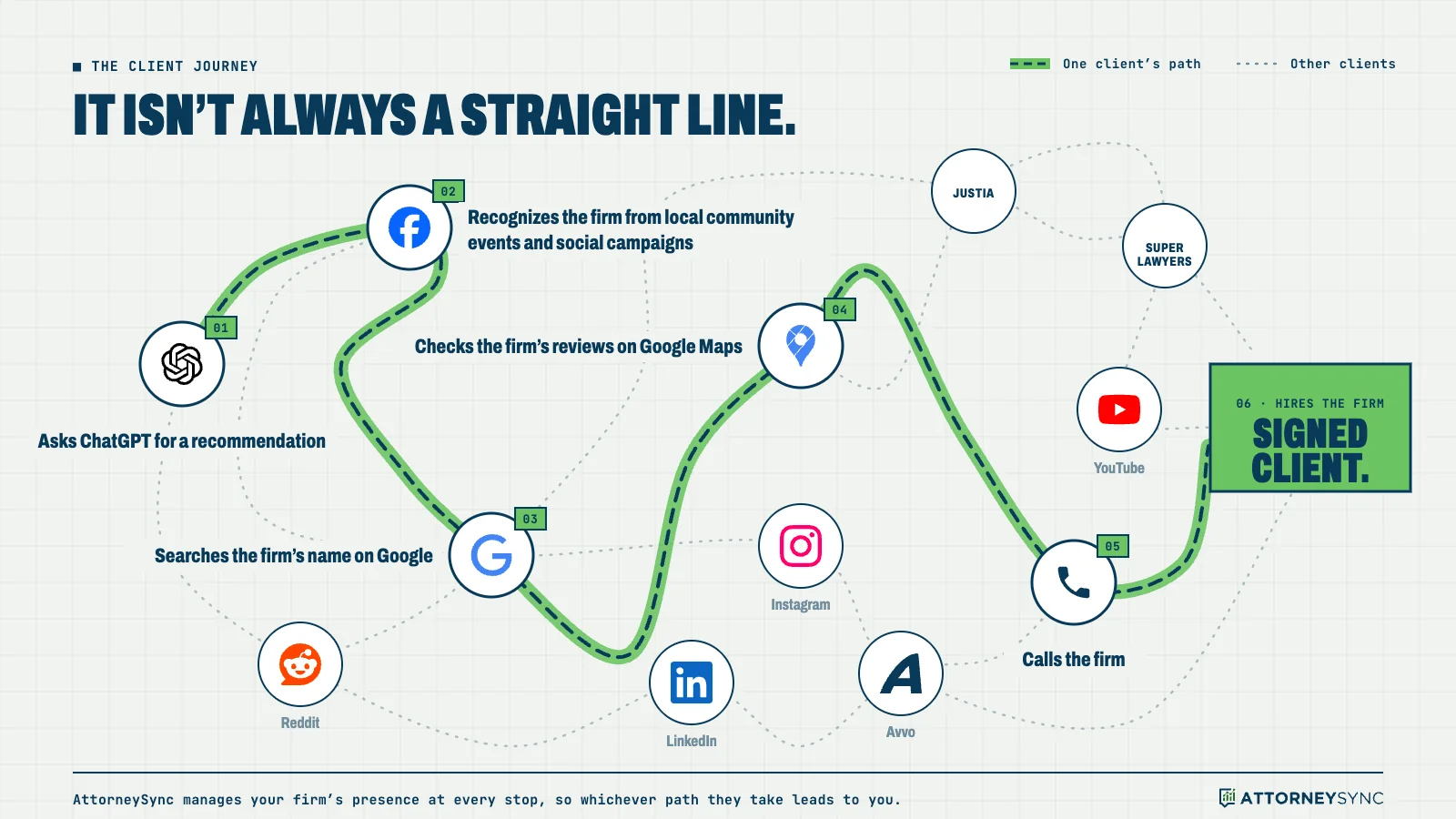
Put simply, people don’t limit their journeys to the moments direct response marketers can see.
They’re living their lives. Most of the time, they don’t need a lawyer at all. And when they finally do, they reach for the names they already know and trust.
Familiarity breeds liking. Familiarity with reputation drives choices.
If your marketing only shows up in that last moment, you’re paying top dollar to compete for people who have already started leaning toward someone else.
I gave a talk on this at Great Legal Marketing’s Digital Marketing Bootcamp. The title was “Why Omni-channel Marketing Eats Single-Channel Direct Response Lunch.” The old me would have heckled from the back row. 🫣
So, what is omni-channel?
These terms get thrown around interchangeably. They shouldn’t.
Multi-channel is running campaigns on a bunch of platforms. Google Ads over here. Facebook over there. SEO with a different agency. Each one judged on the conversions it can claim.
Omni-channel is running those channels as one system. Shared audiences. A consistent brand. Messages that build on each other. Measurement that connects them.
It isn’t about how many platforms you’re on. Some of the best omni-channel programs we’ve seen use a handful of channels really well.
Most firms I talk to already have multi-channel marketing.
Very few have omni-channel marketing.
The difference, in my opinion, mostly comes down to context.
Context is the whole game
The same ad shouldn’t run in every context.
Someone scrolling Instagram on a Sunday night isn’t in the same headspace as someone sitting in an urgent care parking lot searching “do I need a lawyer after a car accident.”
Someone reading a Reddit thread about their landlord isn’t in the same place as someone comparing three firms’ reviews in Google Maps.
So, for every ad, I want to know two things:
- Where is this person in their journey?
- Who is this person, really?
Not “a potential client.” A specific person, in a specific situation, with specific questions and worries.
Get those right and your marketing feels like one firm having a conversation with someone over time. Get them wrong and it feels like a bunch of unrelated ads yelling “CALL NOW.”
Here’s how we actually go about it.
Start with the person, not the platform
Most planning starts with “What platforms should we be on?”
That’s backwards.
Start with the journey. Here’s the rough version we use for most consumer practice areas:
- Not in market. No legal problem. Living life. What they need from you is familiarity. A name, a face, a reason to remember you.
- Trigger. Something just happened. They’re stressed and confused. They need reassurance and next steps, not a hard sell.
- Research. “Do I even need a lawyer? What’s this going to cost? What happens next?” They need honest answers.
- Shortlist. They’re comparing a few firms. Reviews, bios, results. They need proof.
- Contact. They’re ready, but nervous. They need it to be easy, fast, and human.
- Client. They hired you. Now they’re living with the case.
- Advocate. Case is over. Will they review you? Refer you? Remember you?
Then do it again for each practice area. A car crash, a divorce, a DUI arrest, and an estate plan have very different triggers, timelines, and emotions.
Where do you get this stuff? Listen to your intake calls. Read your reviews. Ask recent clients how they found you, and just as importantly, why they chose you. Go read how people describe their problems on Reddit.
You’ll learn more in an afternoon of that than in a month of staring at dashboards.
None of this is new, by the way. Jared Correia and I were talking about the client journey on episode 8 of Clienting back in 2018. The channels have changed a lot since then. The people haven’t.
Listen to what they’re searching
Search is the easiest place to start, because people tell you exactly where they are. We just have to listen.
Here’s how I’d split up car accident searches for a personal injury firm:
- “what to do after a car accident” is research. Show them “What To Do After a Crash: A Lawyer’s Checklist” and send them to an actual checklist. Soft ask.
- “how much is my car accident case worth” is research. Show them an honest explanation of how injury claims are valued. No promised numbers.
- “do I need a lawyer for a minor car accident” is research. Yes, give them a page that tells them when they don’t need a lawyer. Honest advice builds more trust than any slogan.
- “car accident lawyer near me” is contact. “Talk to a Car Accident Lawyer Today.” Short page. Phone number. A three-field form. Reviews.
- “truck accident lawyer” is contact, and it’s a different person. Send them to a trucking page with trucking proof, not your general car accident page.
- “[your firm] reviews” is shortlist. Send them straight to your reviews. Not the homepage.
- “[your firm]” is shortlist or contact. Brand ad with sitelinks to Call, Reviews, Our Attorneys, and Hablamos Español (if you actually do).
Put these in separate ad groups or campaigns so you control what each one gets.
And please look at your search terms reports. Broad match has opinions, and Performance Max will happily blur all of this together if you let it.
Build audiences around what people did
This is where multi-channel starts to become omni-channel.
Instead of targeting each platform on its own, build audiences around what people have done, because that tells you where they probably are:
- People in your area who’ve never heard of you.
- People who watched at least half of one of your videos. They know your face now.
- People who read your research-stage content. Guides, FAQs, “what to do after” posts.
- People who looked at practice area pages, attorney bios, or results.
- People who got to your contact page and didn’t finish.
- People who already contacted you or hired you.
Then sequence your messages across them.
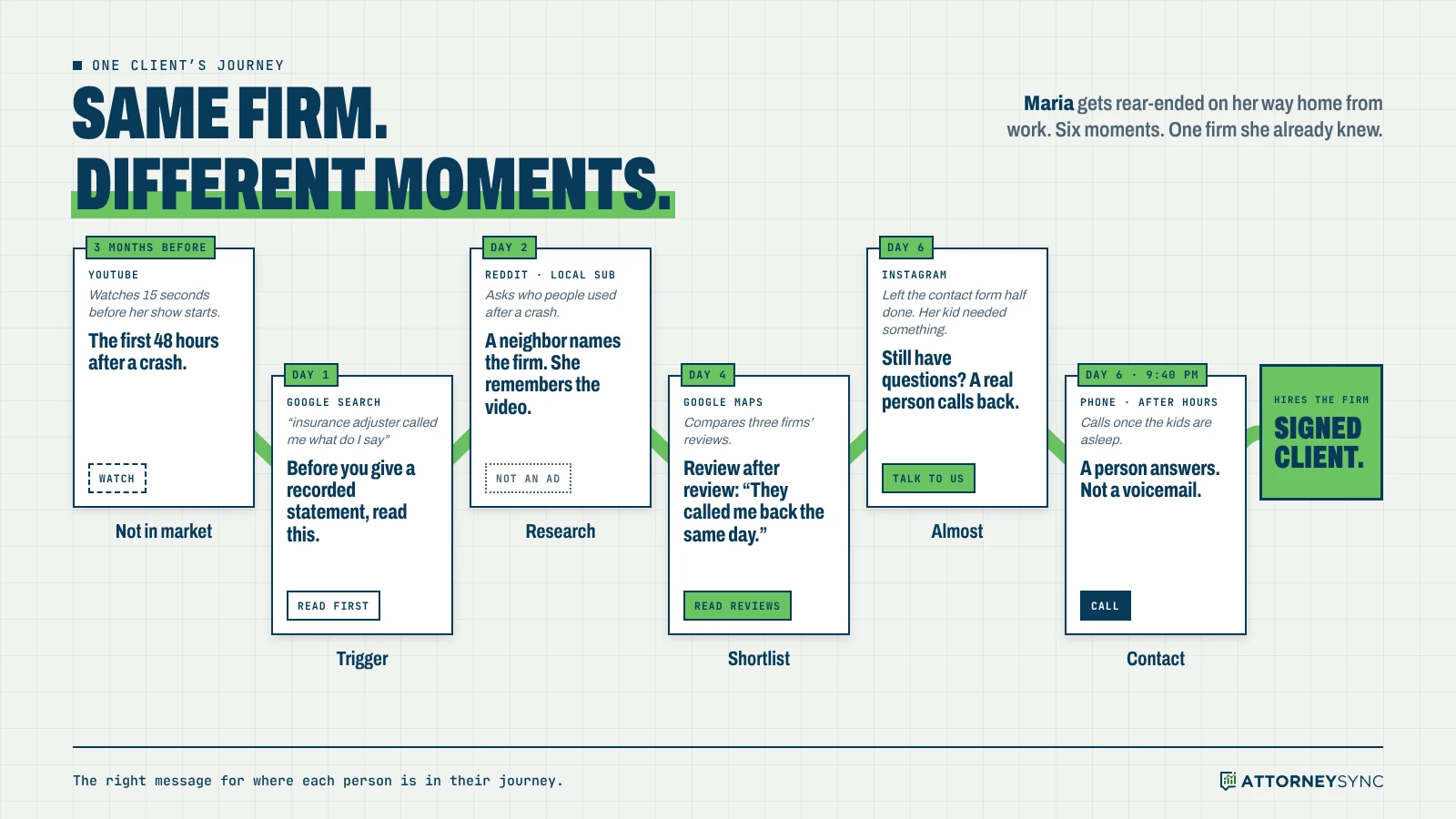
Let’s say Maria gets rear-ended on her way home from work.
A few months earlier, she watched half of a 30-second video where one of your attorneys explained what to do in the first 48 hours after a crash. She didn’t think much of it.
The day after the crash, the other driver’s insurance company calls her. She’s nervous about saying the wrong thing. She Googles “insurance adjuster called me what do I say” and lands on your guide about recorded statements.
The next day, she asks in a local subreddit who people have used after a crash. A neighbor mentions your firm. She remembers the video. (You didn’t pay for that one. But you earned it.)
Over the next few days, she sees a client story on Instagram, then a short attorney bio video. Proof, not pressure.
She checks your reviews on Google Maps. A bunch of them say some version of “they called me back the same day.” She gets to your contact page and bails. (Her kid needed something. Life.)
Later that week, she sees something simple on Instagram: “Still have questions? Talk to a real person. We call back fast.”
She calls that night at 9:40, after the kids are asleep. A person answers. Not a voicemail.
Now, take her out of every acquisition audience. Immediately.
Notice that nothing in that sequence repeats the same pitch. Each piece assumes she saw the last one. You’re continuing a conversation, not starting over every time.
A few things that keep this from going sideways:
- Exclusions. Nothing says “we don’t know you” like showing a “Hurt in a crash? Call us!” ad to someone you signed last week.
- Frequency caps. Familiarity is the goal. Annoying people isn’t.
- Let people move forward. Once someone’s at the shortlist stage, stop hitting them with awareness messages.
- Match the window to the practice area. A personal injury decision might happen in days. An estate plan might take months (or years).
One message, lots of translations
Consistency doesn’t mean running the same ad on every platform.
It means everything comes from the same place.
Before anyone writes an ad, I want to know:
- What’s the one thing we want people to believe about this firm? For example, “We treat you like a person, not a file number.”
- What makes that believable? Reviews. Response times. How you communicate. Credentials. Results, where your rules allow them.
- How do you sound? Calm? Fierce? Plain-spoken?
- Who’s the face? People hire people. Put real lawyers on camera.
Then translate it for each context. Take “a person, not a file number”:
On YouTube, it’s an attorney talking to the camera for 20 seconds about why they return every call themselves.
On Instagram, it’s a client describing what it felt like to get a text from their lawyer on a Saturday with an update.
On Google, it’s “Talk to an Attorney Today. Real People. Fast Callbacks.”
On your Google Business Profile, it’s responding to every review personally.
On the phone, it’s a human answering quickly and following up the same day.
Same idea. Very different execution. Each one fits what the person is doing at that moment.
Some examples by practice area
“Personal injury client” isn’t a segment. Neither is “family law client.” Here’s what I mean.
Personal injury
Motorcycle riders often feel like insurers, juries, and even lawyers think they’re reckless. That’s the context. If one of your lawyers actually rides (please, only if it’s true), that’s your awareness content. Sponsor the local charity ride and show up to it. Retarget the people who watched that video with “What to do after a motorcycle crash when the other driver says they didn’t see you.” When they’re comparing firms, make sure they find reviews from other riders.
Trucking crash victims are different people with different stakes. Bigger injuries, bigger defendants, different evidence. They need to see that you know federal trucking regulations and how to preserve the data from the truck before it disappears. A generic car accident ad wastes their attention.
Spanish-speaking clients aren’t a translation project. It’s the whole journey in Spanish. Ads, landing pages, videos, reviews from Spanish-speaking clients, and someone who speaks Spanish answering the phone. If your ads are in Spanish and your intake isn’t, you’ve wasted the ad.
If you want to hear how a firm actually does this, check out my conversation with Gustavo Munguia on Clienting about how Custodio & Dubey leans into community to build affinity. They create content for the Spanish-speaking community and pair it with paid and organic campaigns.
Family law
Family law is a great example of one practice area holding people in completely opposite situations.
Lisa is thinking about filing. She might research for months, quietly. She wants to plan and protect herself before anyone knows. She searches “how to prepare for divorce” and finds your guide on the documents to gather first. Later, she watches a two-minute video from one of your attorneys about what the first meeting is actually like. When she’s comparing firms, the reviews that matter to her mention words like calm, discreet, and responsive.
Dave just got served. Totally different context. There’s usually a deadline to respond, and he’s caught off guard. He searches “served with divorce papers what now.” He needs a page that explains the deadline in plain English with your phone number at the top. He doesn’t need your brand video right now.
Parents don’t search “how do I get divorced.” Their question is “what happens to my kids?” Lead with that.
Business owners are worried about the business. Their search should land on a page about valuation and keeping the company running, not your general divorce page.
And keep your family law retargeting boring. Firm name, attorney photo, “Family law. Thoughtful counsel.” No “divorce” in the headline. Someone else might be looking at that screen.
Criminal defense and DUI
A DUI journey can go from trigger to contact in one night.
That makes time the context. Pull your call data and look at when calls actually come in. If a lot of them are nights and weekends, either staff those hours or stop running “call now” ads when no one’s going to answer. If you do answer 24/7, say so: “DUI Lawyer Available Tonight. Talk to an Attorney, Not a Voicemail.”
Deadlines are also context. In many states, people have a short window, sometimes just days, to request a hearing to fight a license suspension. An ad that explains that is useful, not a scare tactic. (Confirm your state’s deadline before you run it.)
And the segments matter:
- A first-time DUI is mostly fear and embarrassment. Give them a calm, step-by-step page on what happens next.
- A commercial driver’s livelihood is on the line. A DUI can cost them their CDL, even if it happened in their personal car. That’s the ad.
- Nurses, teachers, pilots, and other licensed professionals are worried about their licensing board. Talk about that.
- In college towns, the person searching often isn’t the person who was arrested. It’s Mom or Dad. “Your child was arrested at [University]. Here’s what to do next.” Talk to the parent. They’re often the one hiring you.
On social, a lot of criminal defense firms are better off with very light retargeting or none at all.
Estate planning
Almost nobody wakes up urgently needing an estate plan.
So the not-in-market and research stages do most of the work, and life events are the triggers.
Jen and Mike just had their first kid. Neither of them has ever thought about a will. But somewhere around month three, one of them sees a 30-second video from one of your attorneys (who’s also a parent) about the one document every parent should have. It sticks.
They see an ad for a free guardianship worksheet. They download it. That starts a short email series: why it matters, what a basic plan includes, what it costs, and what the first meeting looks like.
They open a couple of those emails and look at your pricing page. Now they see reviews from other parents: “They made it easy, and we finally got it done.”
They get to your scheduling page and don’t book. They see: “Book a 20-minute call. Evening times available.” Because when else are new parents going to do this?
They book. They sign. Stop the acquisition ads. Start the client experience.
A year later, you send a note: “Anything change? Time to update your plan?”
Business owners, adult kids worried about aging parents, and recent retirees all have their own versions of this. LinkedIn is a good place to reach business owners. A webinar co-hosted with a local CPA on “what happens to your business if something happens to you” can work really well.
The ones that cut across everything
Referring lawyers are a completely different audience. They don’t need to be convinced they have a legal problem. They need to know you’ll take care of their client and keep them in the loop. LinkedIn works here. And follow your state’s rules on referral fees.
People who contacted you but didn’t hire you aren’t one group. If they weren’t a fit, don’t retarget them. Refer them somewhere helpful. They’ll remember that. If they were undecided, follow up with answers to the questions they actually asked. If they hired someone else, leave them alone.
After-hours callers who never reached anyone? Your call tracking knows who they are. Call them back first thing.
Past clients aren’t an acquisition audience. They’re a relationship. Stay in touch. Send something useful. Remind them you’re around when their brother-in-law gets in a wreck.
Nobody does this better than Chuck Boyk. His firm has been mailing The Boyk Bulletin to past clients and referring attorneys every month for years, and he credits it with millions in cases. We talked about it on Clienting: How Chuck Boyk Does Clienting With The Boyk Bulletin. It’s a great reminder that one of your most effective channels might literally arrive in a mailbox.
Don’t forget the stuff you don’t buy
I see a lot of firms spend real money getting people to an experience that breaks every promise the ads made.
Intake is a channel. If your ads promise fast, human responses and the phone goes to voicemail, you wasted the whole sequence. Listen to your calls. I’ve said this before: you’re probably getting qualified leads. They’re just hiring someone else.
Trey Harrell put marketing in charge of intake at his firm, and he keeps real people, not chatbots, on those first calls. He told me why on Clienting: How Trey Harrell Helps His Community to Earn Clients. Zack Port made a similar point about putting trust over tech. Use AI behind the scenes. Keep the first conversation human.
Reviews are your shortlist message. At that stage, they’re doing more selling than your ads. Ask at the right moments, like when a client says, “I don’t know how to thank you.”
Your website should match the stage. Research visitors need answers. Shortlist visitors need proof. Contact visitors need a phone number and a short form. If every page is a wall of “Call Now,” you’re talking past most of the people who visit.
Be careful with context you can’t see
I’m a lawyer (non-practicing), so you knew this section was coming.
People looking for lawyers are often dealing with something painful or private. Context cuts both ways.
Think about who else sees the screen. Someone researching divorce or criminal defense might share a phone or a laptop with a spouse or a parent. A retargeting ad that says “Thinking About Divorce?” can do real harm.
Know the platform rules. Meta, for example, doesn’t allow ads that assert or imply personal attributes. “Were you injured?” or “Facing a DUI?” can get rejected. Honestly, it’s better practice anyway. Speak to the situation, not the person’s private business. Google and Meta also restrict some targeting and retargeting around sensitive situations, so check the current policies before you build audiences, not after your campaigns get disapproved.
Be careful with client lists. Uploading client or lead lists to ad platforms can reveal who your clients are, and under Rule 1.6, even the fact that someone is a client can be confidential. Get informed consent, or don’t upload the list.
Advertising to an audience isn’t solicitation. Reaching out to one specific person you know needs a lawyer might be, under your state’s version of Rule 7.3. If a tactic feels like it’s aimed at one known person, run it by ethics counsel.
And every jurisdiction’s advertising rules apply to every channel. Social posts, videos, retargeting, all of it. Have the firm review creative before it runs.
Yes, you can measure this
Here’s the part my old direct response self would have struggled with most.
If you judge every channel by last-click conversions, your awareness and research work is always going to look like it’s failing. It isn’t designed to win the last click. It’s designed to make the last click happen.
On behalf of your competitors, thank you for cutting it.
But “just trust us, brand works” isn’t good enough either. And the answer to limited attribution is more attribution, not less. Here’s what we look at:
- Cost per signed case, blended. All marketing spend divided by signed cases. Track it over time. This is the one that pays the bills.
- Brand search. If you’re building familiarity, more people should be searching your name. (With some caveats about AI Overviews.)
- Better intake questions. Don’t just ask “How did you hear about us?” Ask “Where did you first hear about us?” and “Why did you choose us?” Leave them open-ended. The answers are often surprising.
- Call tracking and CRM tied to outcomes. Signed cases and fees, not just leads. If you’re running Google Ads, import your offline conversions.
- Conversion rates by audience. Do people who saw your earlier-stage messages convert better? In our experience, usually.
- Holdout and geo tests. Want proof? Turn awareness spend up or down in one area and compare it to a similar area. It beats arguing about attribution models.
And be skeptical of platform reporting. Every ad platform wants credit for every conversion. Add them all up and you’ll often have “signed” more clients than you actually did.
Where to start
I have no idea what the right plan is for your firm. I don’t know your market, your practice areas, or your goals.
But if you’re all-in on direct response today, here’s roughly how I’d start:
- Fix the end of the journey first. Intake, reviews, Google Business Profile, and a website that answers questions. There’s no sense building familiarity that leads to a bad experience.
- Pick one practice area. Map the journey. Figure out the segments.
- Add one awareness channel and one retargeting sequence. Short attorney videos on YouTube and Meta, plus review-focused retargeting, is a solid start for a lot of consumer practices.
- Move some budget. Shift a slice of what you’re spending on the most expensive last-click keywords into familiarity and trust. Give it enough time and money to actually work.
- Set your baseline first. Brand search, cost per signed case, and what intake is hearing. Then watch them over months, not days.
- Expand what works.
I still love SEO
I really do. It’s still a big part of what we do at AttorneySync, and I still want to know exactly what’s driving calls.
Omni-channel didn’t replace our direct response roots. It grew out of them. All those years of tying marketing to signed cases are exactly what showed us how much was happening outside the last click.
But I’ve watched too many people find, evaluate, and choose lawyers to believe the journey starts with a search and ends with a click. It usually starts long before they need you, winds through more places than you’d guess, and ends with them choosing a name they already know and trust.
The goal isn’t to be the loudest ad in that last moment.
It’s to be the firm they already know when that moment comes, and to say the right thing at each step along the way.
How are you thinking about context at your firm? I’d love to hear what’s working (and what isn’t). If you want more conversations with lawyers who are doing this well, Clienting is back with new episodes. And if you want help building this for your firm, take a look at our omni-channel media services or let’s talk.